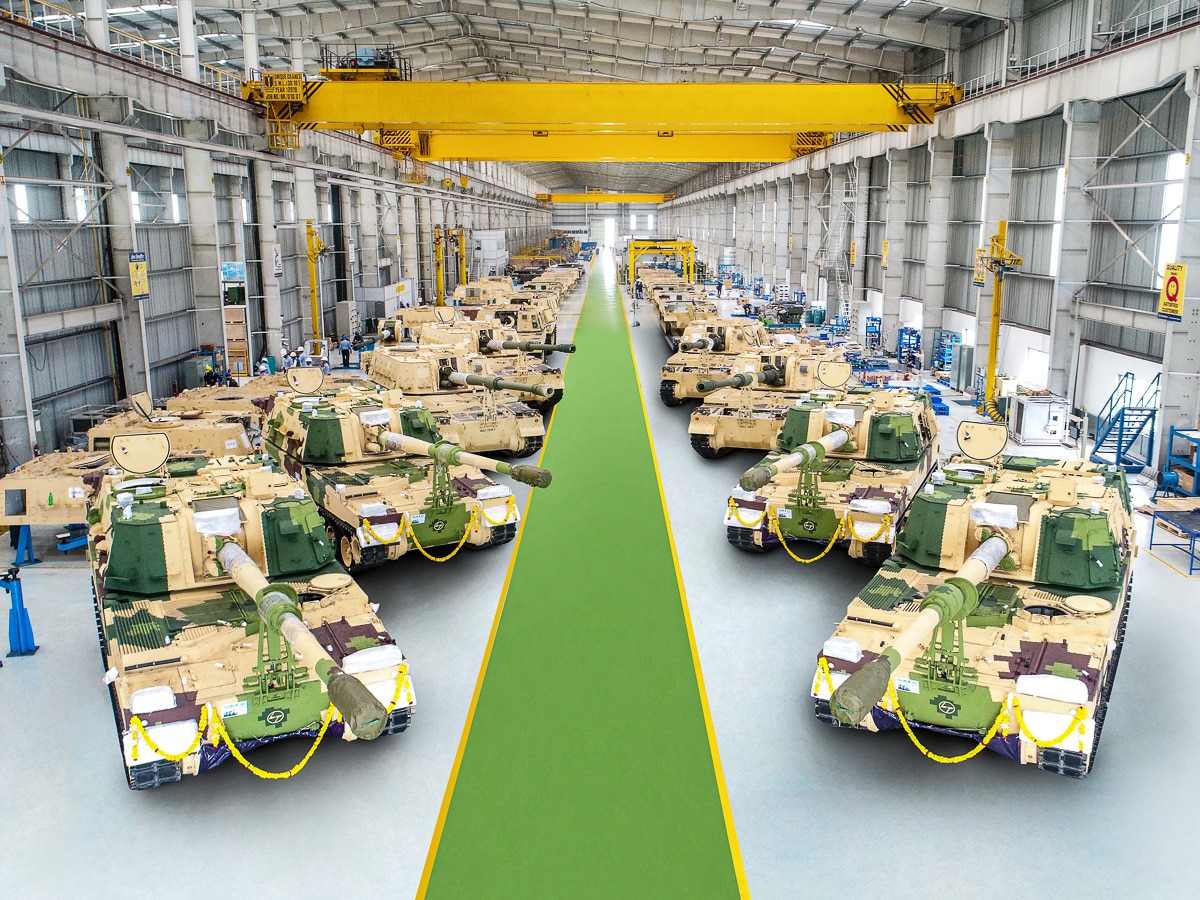
The country's state-owned defence undertakings have so far had a monopoly on the main battle tank programmes, controlling everything from design to systems integration to through-life support.Project Zorawar has changed that. While Larsen & Toubro (L&T) originally partnered with DRDO as lead system integrator to fast-track the sub-25-tonne light tank, the project has since expanded into a competitive multi-vendor ecosystem featuring Tata Advanced Systems and Mahindra Defence. This is a structural shift that analysts call a genuine turning point for India’s armoured vehicle industry, rather than just another private-sector contract win. “It definitely demonstrates competence as far as private companies are concerned in terms of system engineering, configuration management, testing, quality assurance, integration of weapons and sensors. The whole life cycle support would now be responsibility of private companies,” says Col Rajneesh Singh, PhD (Retd), Research Fellow, Defence Economics and Industry Centre, MP-IDSA.Chetan Mehta, founding partner at Aum Ventures, says: “Zorawar is really the first main battle platform where a private player held that role from design through production, rather than being brought in downstream."Also Read: Defence spending gets 15 percent lift, touches 2 percent of GDPA Ladakh-born urgencyThe trigger, according to Singh, was an operational urgency. During the 2020 Ladakh standoff, China’s Type 15 tanks, built for high-altitude terrain at roughly 33 tonnes with a power-to-weight ratio near 33 horsepower per tonne, outclassed India’s 40-tonne-plus T-72 and T-90 fleets, which manage closer to 18-19 horsepower per tonne. That mismatch created an urgent requirement for a lighter, more mobile platform, one India’s DPSU-led model was not built to deliver quickly.What followed was Project Zorawar, which moved from concept to prototype in about 2 years, a significantly high speed for the defence industry. L&T, which had already built expertise through the K9 Vajra self-propelled artillery programme, moved from order to first prototype in under 19 months, and from concept to Army trials in roughly two years. Col Rajneesh contrasts that with the MBT Arjun and the Tejas light combat aircraft, both sanctioned in the early 1980s and still not fully inducted decades later. “If you start counting in terms of years, we are almost 30 years behind,” he says while adding that while Sular in Tamil Nadu does serve as the home base for indigenously built Tejas, the subsequent upgraded aircrafts have not yet been inducted.The compression came not from cutting testing, he notes, but from running user, developer and industry in parallel from day one, reusing existing industrial capability, and iterating prototypes through trials. “So, when the first prototype was tested in desert conditions, and subsequently that prototype was taken to high altitude, the lessons from those trials were incorporated into subsequent prototypes. So, what lesson comes out is that speed came less from eliminating testing. In fact, testing moved at a rather faster pace at the earlier stages of the development, and therefore we were able to shorten the whole program compared to our experience in the past,” Singh explains.This new, faster way of building a major tank has also created opportunities further down the supply chain for smaller tech innovators.“Small tech companies don't need to build an entire tank. They can focus on just one tricky part—like electrical systems, targeting tools, radios, or smart software,” says Rishab Malik, Managing Partner at Jungle Ventures and an investor in Sanlayan Technologies, a defence startup in Bengaluru. He adds that “With the government requiring thousands of parts to be made in India and forcing companies to source up to 60 percent of their materials locally, the main tank builders must now find Indian suppliers for parts they used to import from other countries.”Yet, the real advantage in the business of defence comes from having survived years of military testing and then delivered reliably.Also Read: Graphic of the day: Private sector’s defence leapInvestors see a value-chain upgradeFor investors, that timeline is the headline number. Mehta calls the combination of a committed domestic customer and genuine IP ownership the thing that “makes defence technology investable now,” arguing it can compress timelines that used to take a decade. Kushal Bhagia Founder and Partner at All In Capital frames it as the sector moving up the value chain as private firms that once supplied components or sub-assemblies can now own design, integration and manufacturing of a complete platform, capturing a far larger share of programme value and making the businesses themselves investable at greater scale. “For investors, that creates the possibility of backing businesses that are not just vendors, but can build IP, own platforms and participate in much larger programmes over a longer period of time,” he adds.The export questionBoth investors, along with Singh, are careful to separate that credibility from an automatic export pitch. Winning a domestic order is not the same as winning a tender in the Global South, where competitiveness depends on sustained serial production of dozens to hundreds of units, a proven in-country spares and after-sales network, and pricing that beats established suppliers such as from Russia, China, Turkey, and South Korea, Mehta believes.Col Rajneesh adds that a domestic precondition for export is that Zorawar first needs to be reliably inducted into Indian armed forces and demonstrate competitive life-cycle costs before export credentials mean much at all.L&T is no longer aloneTata Advanced Systems and Mahindra Defence have both since been cleared to build their own prototypes, turning what began as a single company’s programme into a wider contest among private players for future armoured-vehicle orders. Forbes India reached out to Tata Advanced Systems and Mahindra Defence for comment on how they view the shift underway in tank manufacturing but both companies declined to comment.Also Read: Graphic of the day: India's largest defence dealsWhat Happens to DPSUsThis pivot in India’s defence manufacturing does not leave the state-owned entities such as the Heavy Vehicles Factory, Avadi, with a demotion. Both Mehta and Singh expect a bifurcated market as DPSUs anchoring legacy platforms such as Arjun variants and the T-72/T-90 fleet, plus large-volume serial production, heavy fabrication and the overhauls and mid-life upgrades that recur through a tank’s service life.Far from sidelining public infrastructure, this evolving landscape reframes the industry around performance and capability rather than ownership. “Greater competition is inevitable, and I think that is ultimately positive. Capital will increasingly move towards companies that can demonstrate better technology, execution and cost efficiency-- whether that company is public or private should become less important,” says Bhagia.The requirements driving that new generation have shifted too. Col Rajneesh describes tanks moving from a triad of armour, gun and mobility toward “an integrated network combat platform,” shaped by lessons from Ukraine and West Asia on drones, electronic warfare and unmanned teaming; Zorawar’s own programme has already folded-in loitering-munition integration. Mehta reads the same signal as a capital-allocation cue: sensor fusion, defence AI and autonomous systems, not tonnage, are becoming the real differentiator.But what of the larger military tech ecosystem? As Malik puts it, deep tech defence was never a poor investment, it was always a test of patience. “Revenue arrives slowly before it compounds, while the advantage you build becomes very hard for anyone to replicate,” he adds.Also Read: How GalaxEye's Mission Drishti can shore up defence and agricultureThe larger pictureCol Rajneesh sees Zorawar as part of a broader pattern rather than an isolated case, pointing to missile manufacturing, where Bharat Dynamics’ monopoly on conventional systems is also being opened to private players. If that reading holds, Zorawar’s real significance may lie less in the tank itself than in what it proves is now possible to build, and finance, underneath it.
Read Full ArticleThis article was originally published on forbesindia. Click the button above to read the complete article.